
There is a simple idea in math.
If you can add one, you can keep adding one.

If you can replicate a unit, you don’t grow linearly anymore. You grow exponentially.
At first it looks small. One becomes two. Two becomes four. But eventually, the system stops behaving like counting. It becomes something else entirely.
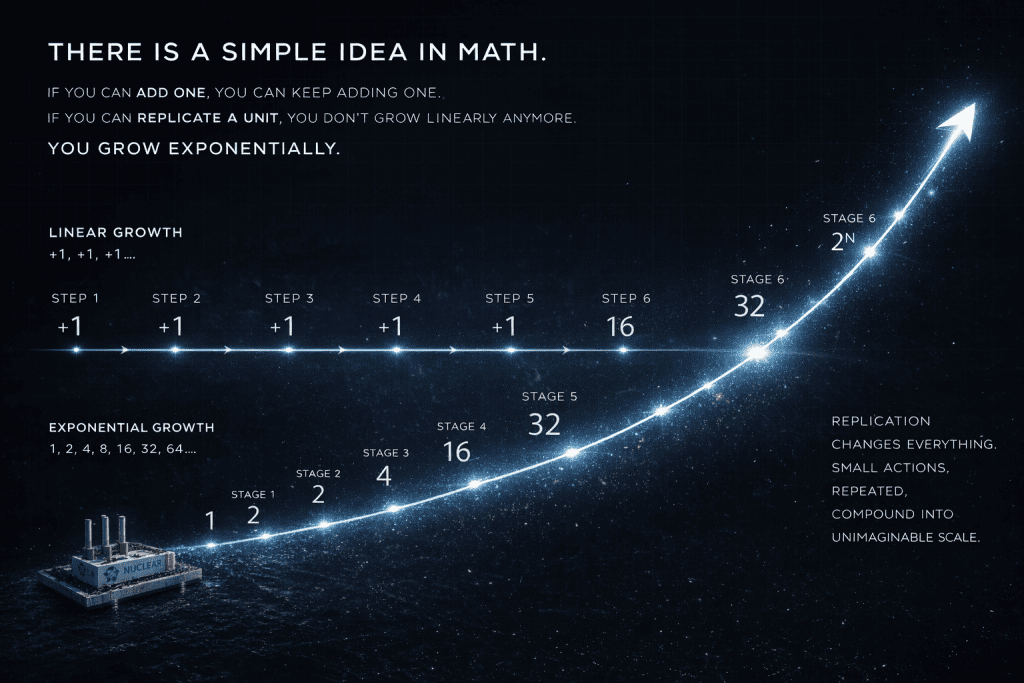
Energy systems follow the same rule.
If a system can produce energy, and that energy can be used to build more energy systems, then energy production becomes recursive. Energy is no longer just an output.
It becomes an input into its own expansion.
This is the foundation of parabolic growth in electricity.
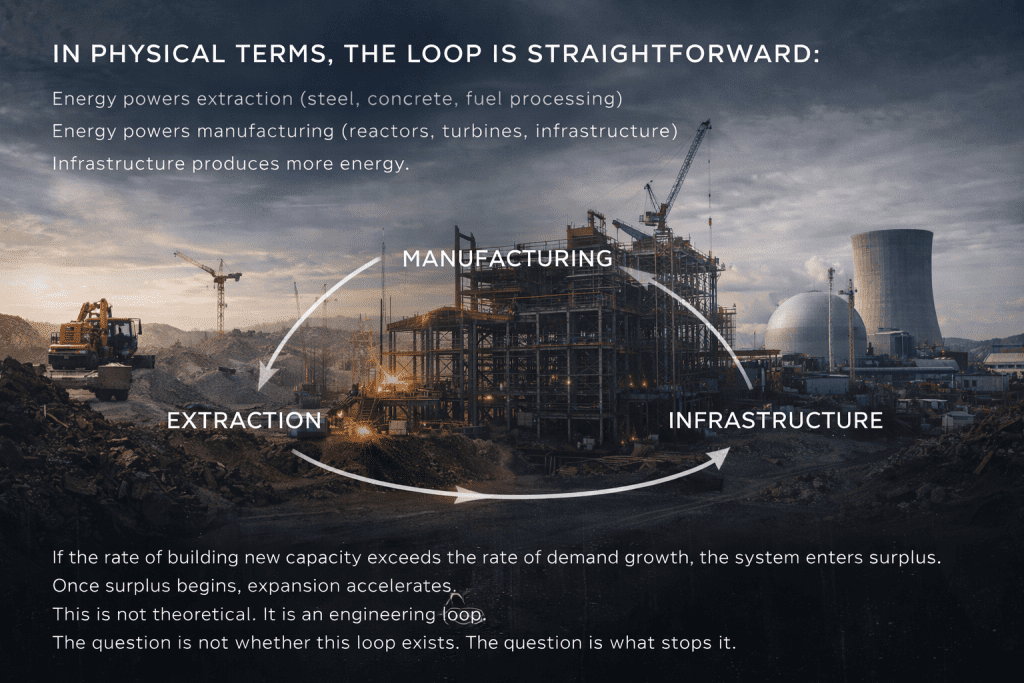
In physical terms, the loop is straightforward:
Energy powers extraction (steel, concrete, fuel processing)
Energy powers manufacturing (reactors, turbines, infrastructure)
Infrastructure produces more energy.
If the rate of building new capacity exceeds the rate of demand growth, the system enters surplus. Once surplus begins, expansion accelerates.
This is not theoretical. It is an engineering loop.
The question is not whether this loop exists. The question is what stops it.
Every attempt to scale runs into the same walls: land, distance, materials, security, control.
Most proposed large-scale energy systems fail under one or more of these constraints.
Solar flotillas, for example, appear scalable at first glance. The ocean provides surface area, and sunlight is abundant. But the system breaks under analysis.
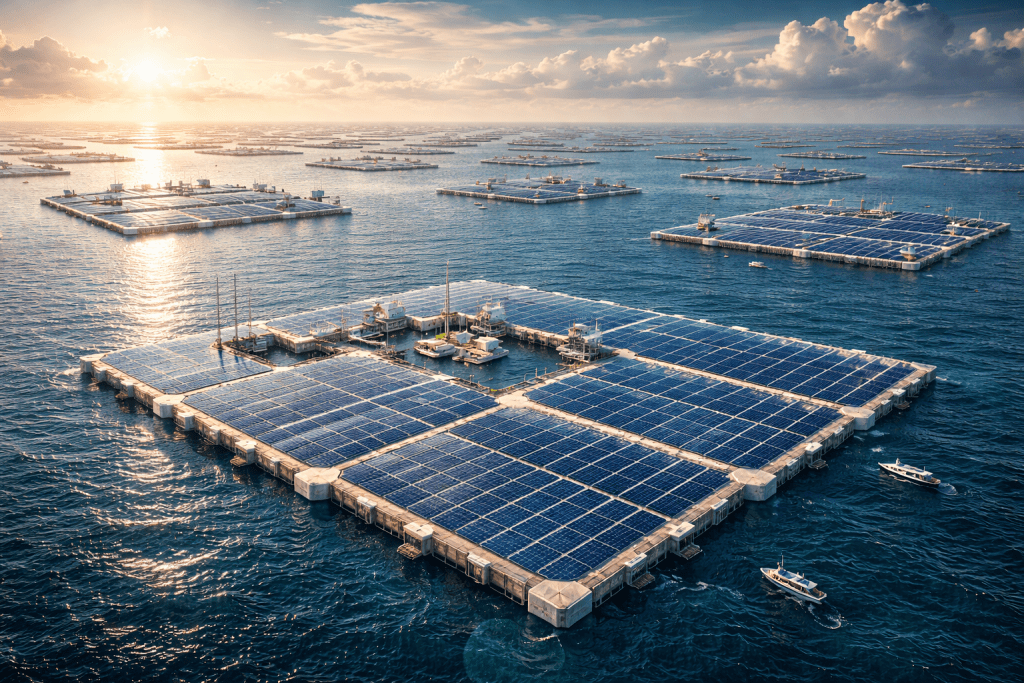
They require continuous, massive surface coverage. They are geographically distributed across thousands of miles. That makes them difficult to defend, difficult to maintain, and highly vulnerable to weather and saltwater degradation. Any large-scale deployment becomes a soft target. There is no practical way to secure that much exposed infrastructure.
From a purely technical standpoint, distributed ocean-wide solar systems are not compatible with controlled, exponential scaling.
Nuclear energy is.
The difference begins with energy density.
Nuclear fuel contains orders of magnitude more energy per unit mass than fossil fuels, and vastly more than solar or wind when normalized by land or surface area.
To put it simply:
1 kilogram of uranium can produce ~24,000,000 kWh of energy
1 kilogram of coal produces ~8 kWh
This is not a marginal improvement. It is a different category.
Safety data reflects this difference in another way.
Measured in deaths per terawatt-hour (TWh):
Coal: ~24.6 deaths/TWh
Oil: ~18.4 deaths/TWh
Natural gas: ~2.8 deaths/TWh
Hydropower: ~1.3 deaths/TWh (higher when including dam failures)
Nuclear: ~0.03 deaths/TWh
Nuclear is, statistically, the safest major energy source ever deployed at scale.
This includes historical accidents. Even when those are counted, the numbers remain lower than every alternative.
Deployment speed is often misunderstood.
When large amounts of reliable power are needed, nuclear is one of the only systems capable of delivering continuous, high-output energy without dependence on weather or storage.
In recent years, governments and private industry have:
Extended the life of existing nuclear plants
Restarted previously shut-down reactors
Accelerated development of small modular reactors (SMRs)
Secured nuclear capacity specifically to support high-demand infrastructure, including AI data centers.
When demand becomes non-negotiable, nuclear reappears.
The primary regulatory constraint is distance.
In the United States, nuclear facilities are typically required to maintain an emergency planning zone of approximately 5 miles or more from dense population centers.
On land, this creates friction.
In the ocean, it becomes trivial.
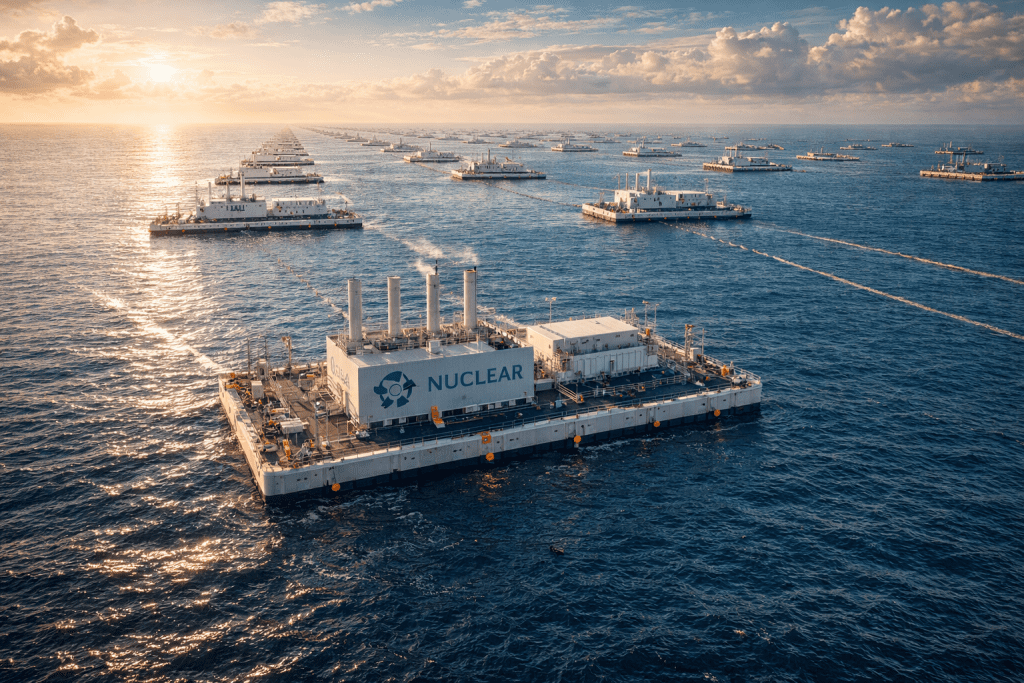
This is where the barge model becomes practical.
A nuclear barge is not a theoretical object. It is a configuration.
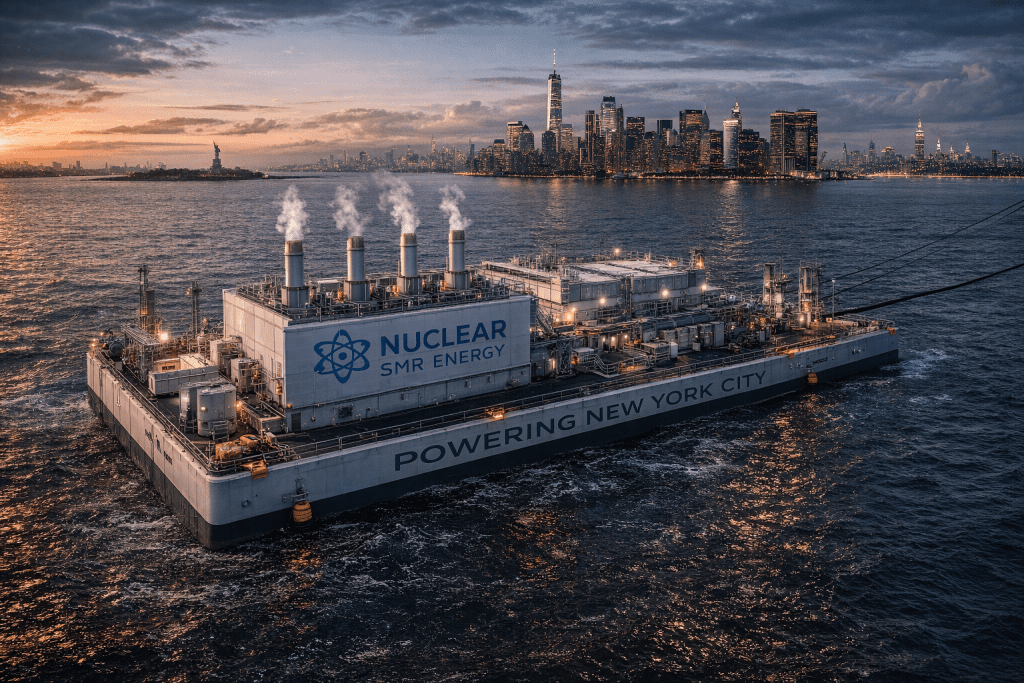
Modular reactors, factory-built
Mounted on marine platforms
Positioned offshore, beyond minimum safety radii
Connected directly to coastal grids
For a city like New York, this solves multiple constraints at once:
Distance: Easily exceeds 5-mile buffer
Land use: No competition with real estate
Transmission: Short distance to load centers
Standardization: Units can be mass-produced
Defense: Centralized infrastructure is protectable
One barge can power the city.
But the important part is not the first barge.
It’s the second.
Once one unit exists, the system can replicate.
Energy from the first system contributes to the construction of the next. Manufacturing becomes continuous. Deployment becomes standardized. Capacity increases in discrete, repeatable units.
This is where the curve bends.
Not slowly. Not over centuries. But as fast as industrial capacity allows.
At that point, the limiting factor is no longer physics.
It is coordination, regulation, and control.
There is also a strategic reality.
Energy infrastructure is not just an engineering problem. It is a control system.
Large-scale, distributed energy networks are difficult to secure and difficult to regulate. Systems that can scale rapidly and independently threaten existing industries that depend on controlled scarcity.
A centralized, modular system—like nuclear barges—is easier to defend, easier to monitor, and easier to integrate into existing grids.
That is not a side note. That is one of the reasons certain systems move forward, and others do not.
If enough units are deployed, the system crosses a threshold.
Energy production begins to outpace the cost and time required to build new capacity. Surplus energy accelerates infrastructure. Infrastructure accelerates energy.
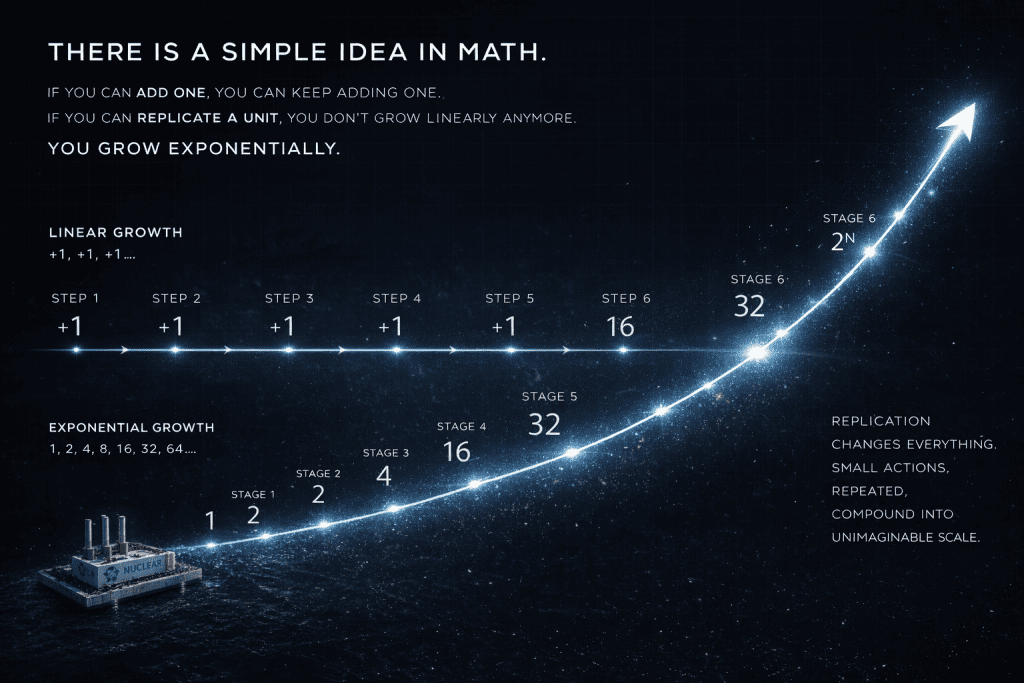
This is the parabolic phase.
At that point, growth is no longer constrained by fuel, land, or technology. The system feeds itself.
The loop exists.
The materials exist.
The energy exists.
So the constraint is not physical.
We have already systems built capable of powering entire cities from a single installation.
The only remaining question is whether we allow the curve to turn upward.
Because once it does, it doesn’t stop.