
Markets tend to follow a predictable pattern.

Access is limited early, ownership consolidates quickly, and participation becomes restricted to those who already have capital. Infrastructure, once built, is no longer broadly accessible. It is controlled.

This system starts differently.
Ownership of modular reactors and nuclear barges is restricted to individuals only.
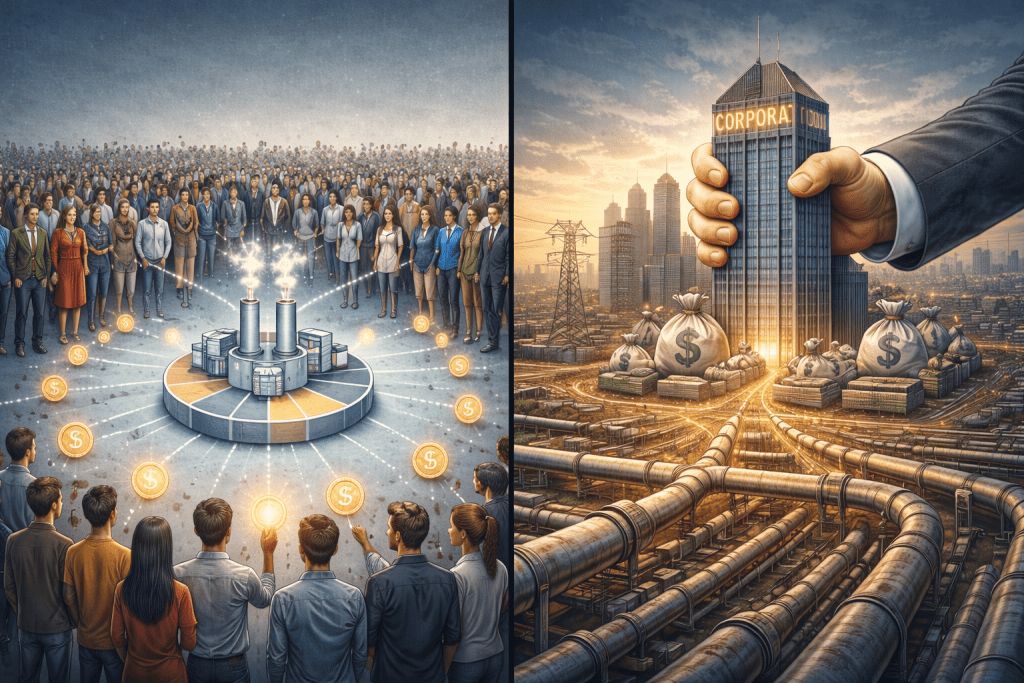
No corporations, no funds, no institutional accumulation. This is not a philosophical choice. It is a structural one. If organizations are allowed to participate at the root layer, consolidation happens immediately. Preventing that at the beginning is the only way to keep the system open as it scales.
All ownership is held and tracked through the Bank of the Federation. The Bank functions as the primary exchange and registry. The Bank does not produce energy. It records ownership, enforces limits, and settles transactions.
With potentially billions of participants buying and selling micro amounts continuously, a centralized ledger is required for the system to function.
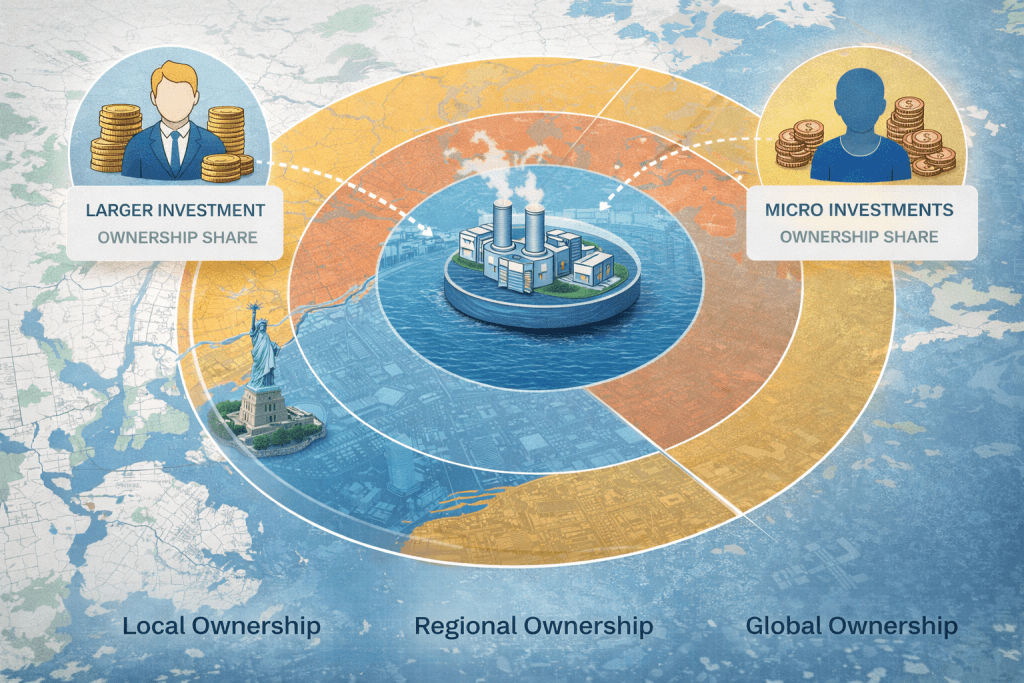
Ownership is not unlimited. It is bounded by jurisdiction.
Each reactor or barge is divided into ownership brackets tied to physical and political reality. For example, in a system supplying New York City:
Residents of New York City may collectively own up to a defined percentage of the total system (e.g. 5%)
Participants within the broader Northeastern grid may have a separate allocation (e.g. 5%)
The remaining ownership is globally available
Once a threshold is reached individually, then there is only one group; Global. These caps are not permanent privileges. They exist to ensure that the people closest to the infrastructure—those most dependent on it—have meaningful access to its output.
Ownership is tied to geography because consumption is tied to geography.
At the individual level, participation is open. The rich can buy larger shares immediately, up to the allowable limits. The poor can enter at any scale, purchasing micro amounts over time. There is no minimum threshold for participation.
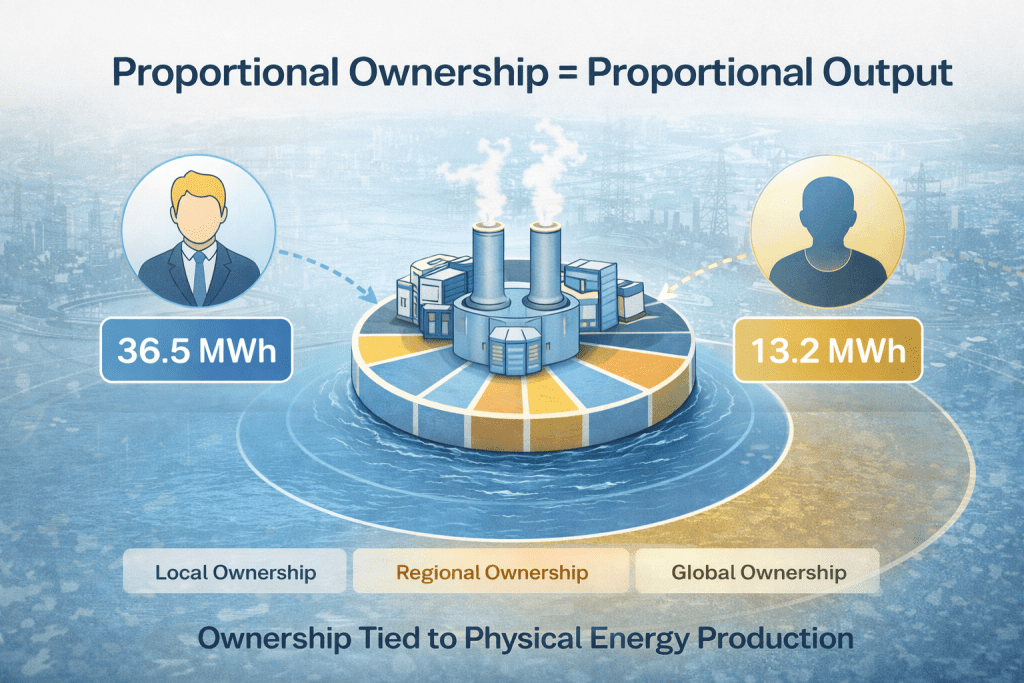
Ownership corresponds directly to production.
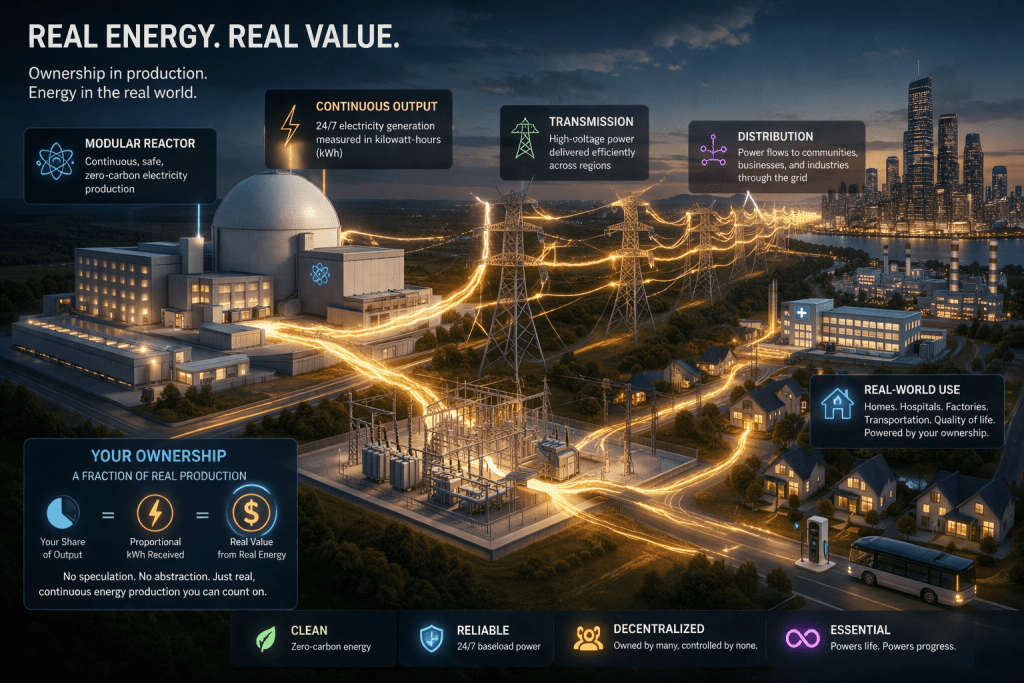
If an individual owns a fraction of a reactor system, they receive a proportional share of its output, measured in kilowatt-hours. This is not an abstract financial instrument. It is a claim on real, continuous production. The value of ownership is grounded in physical energy output.
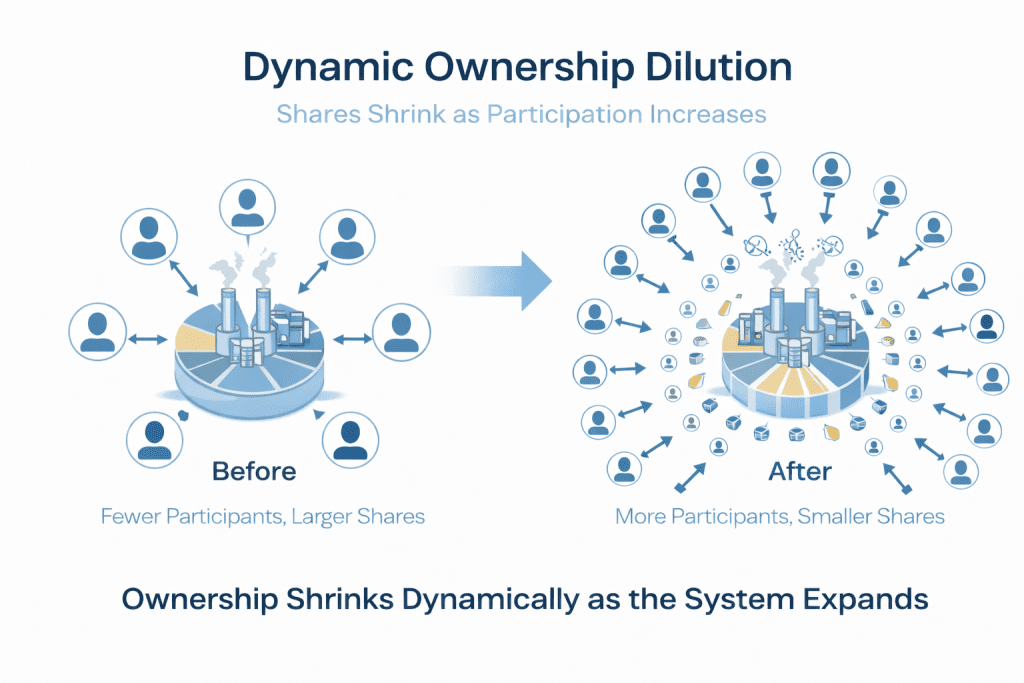
Ownership is also not fixed.
As new participants enter the system, ownership adjusts dynamically. If more people want access to a given reactor or barge, existing shares are reduced proportionally. This is not a loss without compensation. Individuals who are diluted receive payment at market value for the portion they relinquish. At present, this compensation is denominated in USD, due to its existing global liquidity, though other forms of settlement can be introduced later.
This creates a fluid structure:
With fewer participants, ownership shares are larger
As participation increases, shares become smaller
Entry is always possible, and early participants are compensated for making space
Dilution becomes a mechanism for expansion, not exclusion.
Participants are free to buy and sell their ownership at any time, subject to the system’s caps. The Bank provides the most efficient venue for this activity, but it is not the only possible mechanism. Trades can occur between individuals, but no one can exceed the maximum allowable ownership within their bracket. The market is open, but bounded. Verification is required.
Ownership is tied to real individuals, validated through their local jurisdictions. This prevents duplication, shell accumulation, and automated capture. Ownership must be tied to real individuals. If identity is abstract, ownership becomes gameable. If ownership is gameable, it concentrates.
The result is a system where access is continuous, ownership is adjustable, and participation is universal.
It does not prevent wealth accumulation. Individuals can still acquire significant shares within the allowed limits. But it prevents permanent exclusion. No one is locked out of the system because they arrived too late. Entry remains open, and ownership adapts as the number of participants grows.
Most importantly, ownership is tied to something that is always in demand.
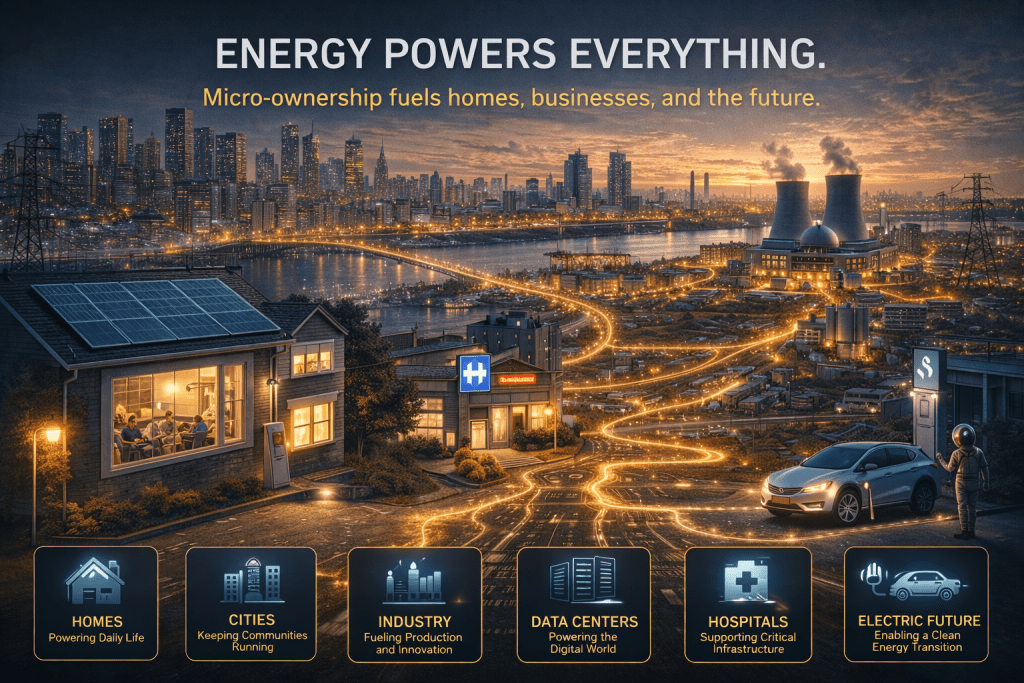
Energy is not speculative. Every home, every business, and every industrial process consumes it. By linking ownership directly to energy production, the system anchors value to something real, measurable, and continuously used.
Ownership does not settle.
It does not lock.
It does not close.
It moves with participation.
It expands with demand.
And because of that—
it never becomes inaccessible.
How about we see what this looks like in practice?